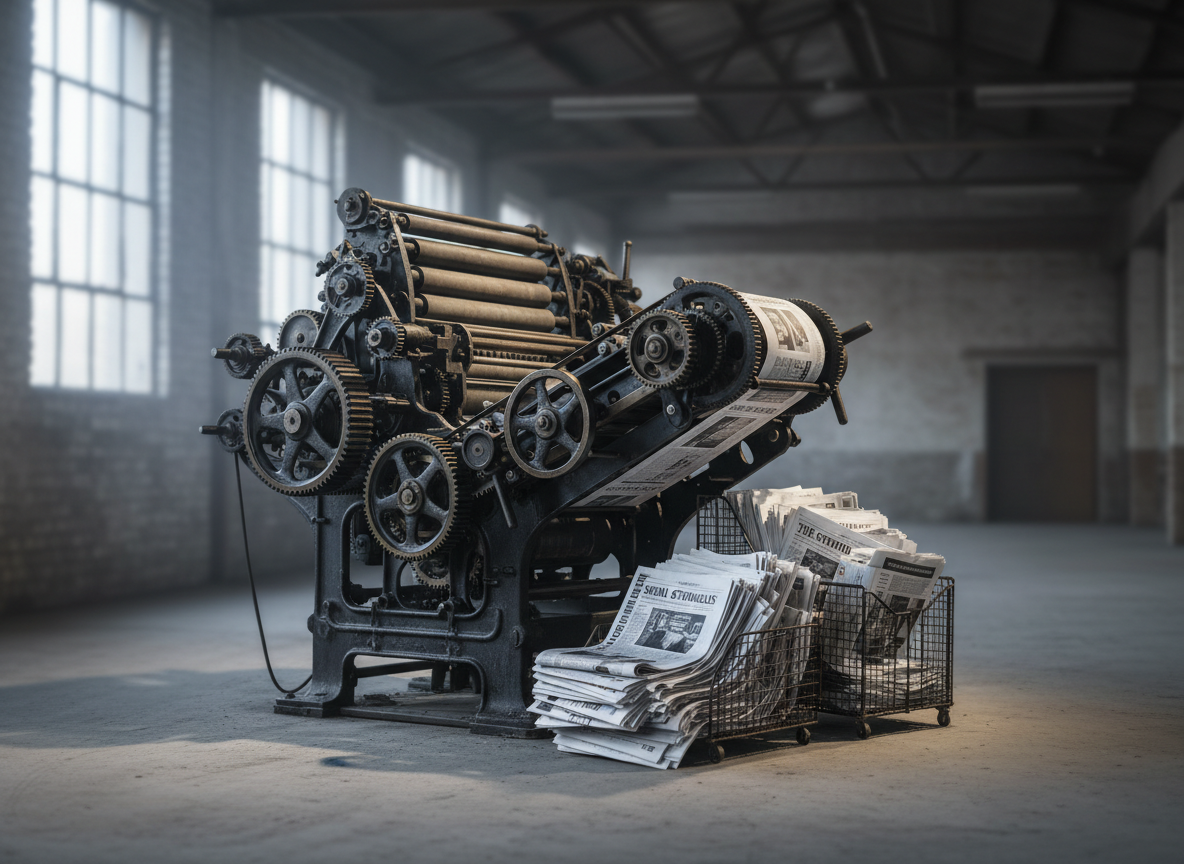
A heavy, weathered newspaper printing press made of dark steel and worn brass, its intricate gears and rollers frozen mid-motion, stands in an empty industrial room. Stacks of freshly printed broadsheets, edges slightly curled, spill from wire racks, headlines about social struggles and the commons visible but not readable. Cold, diffused daylight filters through high warehouse windows, casting long, soft-edged shadows and glints on oily metal surfaces. Photographic realism, eye-level composition with a slight three-quarter angle, sharp focus on the press and shallow depth of field softening the distant walls. The mood is contemplative and serious, evoking an old world of mass media being questioned by critical, postcapitalist thought.

Le Journal

Un média indépendant animé par un collectif engagé, né des luttes pour les communs.

Manifeste

Journaldescommuns.fr est né de la conviction que le vieux monde – productiviste, patriarcal, colonial et marchand – est en crise profonde, et que ses failles ouvrent des brèches pour inventer des formes de vie postcapitalistes. Notre ligne éditoriale croise enquêtes, chroniques sensibles, analyses politiques et récits de luttes, toujours depuis le point de vue des communs : communs matériels (eau, terres, logement, infrastructures), communs numériques et culturels, mais aussi communs affectifs et politiques que produisent les mouvements sociaux. Le projet est issu de pratiques militantes, de collectifs de recherche-action et de médias indépendants, avec le désir de tisser un espace commun entre théorie critique et expériences concrètes. Nous nous inspirons des pensées des communs (Elinor Ostrom, Silvia Federici, Pierre Dardot et Christian Laval, David Bollier…), des traditions marxistes, féministes, écologistes, anarchistes, décoloniales et des épistémologies situées. Le journal se veut un lieu de décentrement et de controverse, où l’on peut à la fois documenter ce qui se défait – l’État social, les territoires, les liens – et ce qui se fabrique : assemblées locales, coopératives, zones à défendre, solidarités de quartier, pratiques de soin, expérimentations démocratiques. Nous refusons le faux neutralisme journalistique : nos textes assument un parti pris pour les subalternes, les territoires en lutte et les formes d’autogouvernement qui déplacent les rapports de pouvoir. En situant nos analyses dans le champ critique, nous cherchons moins à commenter l’actualité qu’à comprendre les structures qui la produisent, à mettre en partage des outils d’intelligibilité et à nourrir les imaginaires politiques nécessaires aux bifurcations à venir.
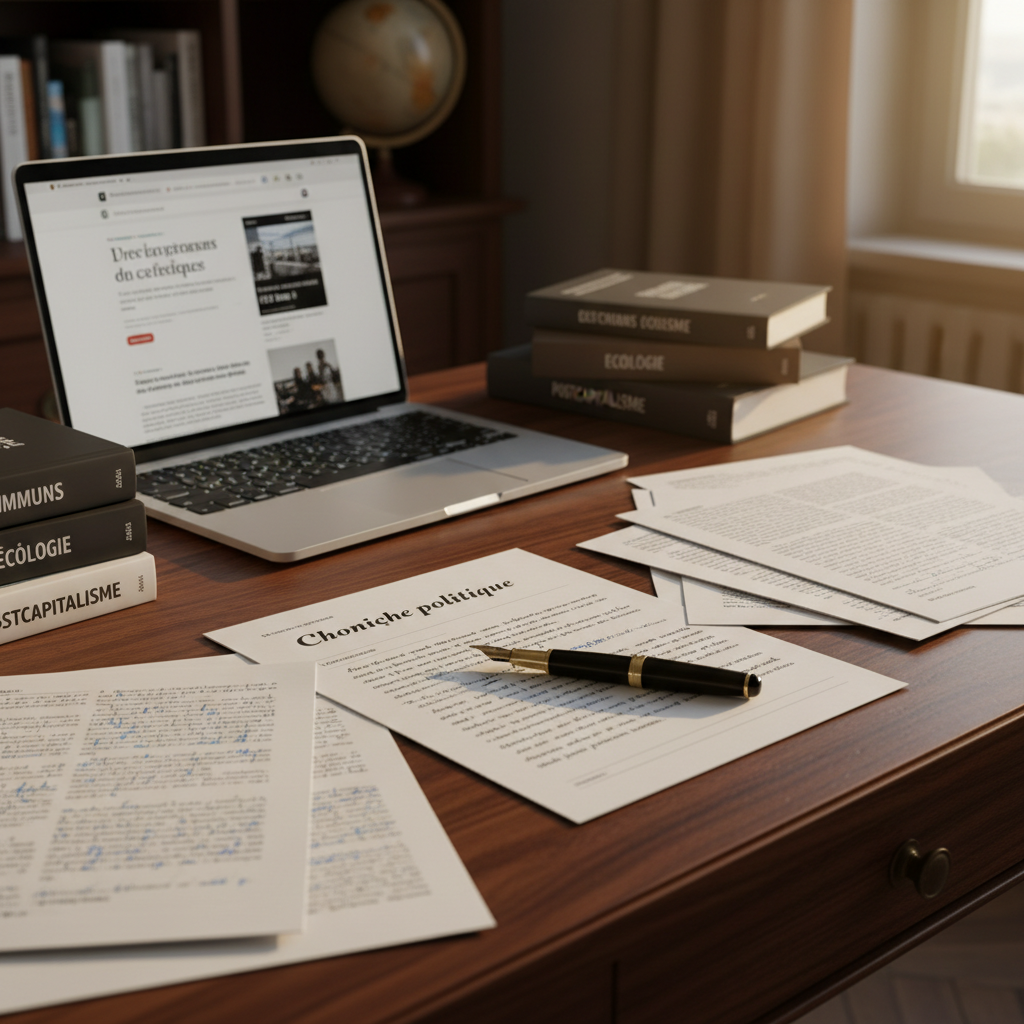
An elegant wooden writing desk with a deep walnut finish, its surface covered in annotated printed articles, open notebooks, and a vintage fountain pen resting on the margin of a page titled “Chronique politique”. A laptop with a minimalist news site layout glows softly, surrounded by neatly stacked books labeled with themes like “communs”, “écologie”, and “postcapitalisme”. Late-afternoon natural light enters from an unseen window, creating warm highlights on the polished wood and gentle shadows between the papers. Photographic realism with a slightly elevated, three-quarters composition and shallow depth of field, keeping the foreground documents crisp and the background shelves subtly blurred. The mood is thoughtful and sophisticated, suggesting meticulous analysis and slow, careful journalism.

Le Collectif

A heavy, weathered newspaper printing press made of dark steel and worn brass, its intricate gears and rollers frozen mid-motion, stands in an empty industrial room. Stacks of freshly printed broadsheets, edges slightly curled, spill from wire racks, headlines about social struggles and the commons visible but not readable. Cold, diffused daylight filters through high warehouse windows, casting long, soft-edged shadows and glints on oily metal surfaces. Photographic realism, eye-level composition with a slight three-quarter angle, sharp focus on the press and shallow depth of field softening the distant walls. The mood is contemplative and serious, evoking an old world of mass media being questioned by critical, postcapitalist thought.

Aarav Sharma

An elegant wooden writing desk with a deep walnut finish, its surface covered in annotated printed articles, open notebooks, and a vintage fountain pen resting on the margin of a page titled “Chronique politique”. A laptop with a minimalist news site layout glows softly, surrounded by neatly stacked books labeled with themes like “communs”, “écologie”, and “postcapitalisme”. Late-afternoon natural light enters from an unseen window, creating warm highlights on the polished wood and gentle shadows between the papers. Photographic realism with a slightly elevated, three-quarters composition and shallow depth of field, keeping the foreground documents crisp and the background shelves subtly blurred. The mood is thoughtful and sophisticated, suggesting meticulous analysis and slow, careful journalism.

Mateo García

A heavy, weathered newspaper printing press made of dark steel and worn brass, its intricate gears and rollers frozen mid-motion, stands in an empty industrial room. Stacks of freshly printed broadsheets, edges slightly curled, spill from wire racks, headlines about social struggles and the commons visible but not readable. Cold, diffused daylight filters through high warehouse windows, casting long, soft-edged shadows and glints on oily metal surfaces. Photographic realism, eye-level composition with a slight three-quarter angle, sharp focus on the press and shallow depth of field softening the distant walls. The mood is contemplative and serious, evoking an old world of mass media being questioned by critical, postcapitalist thought.

Zuri Ndlovu